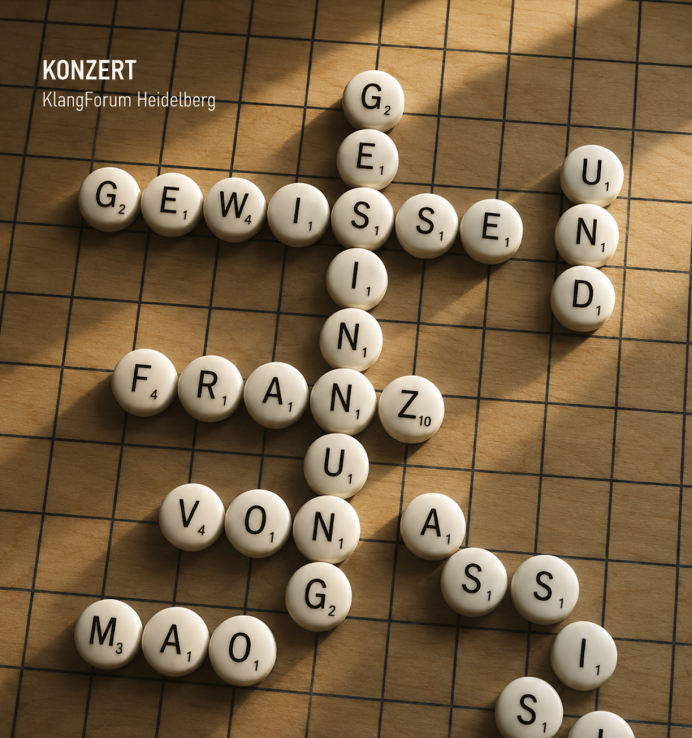
Conscience and Conviction
Franz von Assisi and Mao Zedong
BETRIEBSWERK
- Premiere — Jörg Herchet: Das geistliche Jahr, Kantate zum Festtag des heiligen Franziskus von Assisi, 2026
- Premiere — Shiqi Geng: Cyclus ignis et cineris, 2026
Mitwirkende:
- Sarah M. Newman — Sopran
- Sebastian Hübner — Tenor
- Florian Drexel — Bass
- Brigitte Shatunov — Flöte
- Jaime Gonzalez — Oboe
- Udo Grimm — Klarinette
- Mari Alaff — Violine
- Jessica Kuhn — Cello
- John Eckhardt — Kontra- und E-Bass
- Boris Müller — Schlagwerk
- Steffen Ahrens — Gitarre
- Ronan Whittern — Fagott
- SCHOLA HEIDELBERG | ensemble aisthesis
Leitung: Ekkehard Windrich
Veranstalter: KlangForum Heidelberg
The year 2026 marks the anniversaries of the deaths of two figures whose lives could hardly have been more different: Franz von Assisi (†1226) and Mao Zedong (†1976). Through extreme renunciation and a willingness to make personal sacrifices, one sparked a peaceful mass movement that, in turn, isolated him even during his lifetime and drove him into internal exile. The other sustained a revolutionary upheaval lasting decades, for which he accepted the loss of countless lives. Bringing together such opposite figures certainly provokes critical questions that can hardly be answered in substance within the framework of a conventional concert program.
It is therefore clear from the start that this interdisciplinary concert project—consisting of lectures, a podium discussion, a main concert featuring live-projected photo series, and a moderated late-night concert with an audience discussion—cannot be about morally equalizing two of the most extreme figures in human history. Rather, the aim is to explore the point where these extremes intersect, whatever the historical and personal circumstances may be. For there is no doubt that Franziskus and Mao are united by a common question—along with the uncompromising fundamentalism with which they both sought to answer it—namely, that of social justice and empathy for the disadvantaged. A second, less obvious similarity lies in how the published images of these two figures helped construct their public “image”.
The social question is so old that it can be regarded as a constant in human history, and it appears in various forms in presumably all religions. Awareness of social injustice and compassion for those who are hungry and cold have likely existed for just as long as the bitter experience of failing to eliminate this injustice at its structural root.
Franziskus was born into a wealthy family. When his sympathy for the disadvantaged was sparked, he initially stole money from his father and gave it to the poor—not exactly an honorable thing to do, so far. But shortly thereafter, he did everything in his power to own less than anyone else; he begged and froze, was viciously mocked, and passed on the donations he received to those even more in need. He often performed hard physical labor in fields and on construction sites. Numerous monks and nuns cared for lepers, but despite the well-known risk of infection, Franziskus also generously offered comforting physical contact. He may be famous for miracles whose authenticity is disputed, but from today’s perspective, the strength behind this lifelong commitment is just as unimaginable as the misery of the poor at that time.
Franziskus’s charisma was so strong that others joined him, and within a few years a movement emerged that, through its radical pursuit of Christ’s example, became a threat to the established power of the Church. The Church opted against open repression and instead chose the tried-and-true strategy of incorporating the movement into its own structures. The movement therefore became an order with professional management, making an economically viable foundation inevitable. Franziskus’s firm adherence to principles continued to attract young people across Europe, though they were increasingly concerned with personal educational opportunities and only secondarily with a life of austerity and the practice of faith: The Order of the Poor Friars contributed significantly to the founding of universities in Europe, despite the fierce resistance of its founder. In any case, shortly after returning from the Damietta Crusade (and the unsuccessful attempt to convert Sultan al-Kamil), Franziskus turned his back on his own order and withdrew in resignation with his old faithful followers.
Franziskus was no social revolutionary and did not seek to overturn the social order. He merely took the teachings of Jesus Christ seriously in a fundamentalist sense, applying them to his own life. However, the Church’s co-optation of Franziskus—which had already exerted a moderating influence on his order during his lifetime—continued posthumously in the form of legendary tales, magnificent architecture, and visual depictions: Even in the fresco cycle in the upper church of the Basilica of San Francesco in Assisi—an artistic masterpiece attributed to Giotto—Franziskus is portrayed as the heir to Christ. The aesthetically exaggerated virtue of the saint thus obscures the unprecedented hardships of his life’s journey, which stands in sharp contrast to the reality of the Church. A depiction of Franziskus on a triumphal chariot, such as that by Franz Ludwig Hermann (ceiling fresco in the Franciscan Church in Überlingen), certainly serves as propaganda in this interpretation.
Using a series of these and other culturally and historically significant depictions of St. Franziskus projected onto the screen, we trace the evolution of St. Franziskus’s public image over the past 800 years, set to music that contrasts with the Gregorian Versus alleluiaticus "Franciscus pauper et humilis" and Carlo Gesualdo’s six-part motet "Franciscus humilis", arranged for soprano, oboe, tenor, viola, electric guitar, and bass.
In his St. Franziskus cantata, Jörg Herchet will certainly not cater to the traditional, comfortable image of the saint. In this composition (commissioned by the KlangForum Heidelberg), part of the cycle “Das geistliche Jahr” (The Spiritual Year), which he began as early as 1978, the veteran composer and devoted Catholic explores the elusive driving force of St. Franziskus’s faith and his personality. Herchet sets to music the text by his longtime librettist, Jörg Milbradt, with the stated goal: “…since St. Franziskus so completely shatters all notions of normality, I, too, would like to transcend classical boundaries in the music itself” (email, February 13, 2025). Herchet has some experience in transcending spiritual limitations. Having grown up in the DDR, he viewed dodecaphony at the time as a compositional act of resistance against real-socialist control. He interprets Franziskus’s work in terms of its early Christian defiance—directed against the mindless hustle and bustle of everyday life and driven by a deeply human conscience.
Mao’s legacy defies imagination, at least as far as the death toll is concerned. Wikipedia cites 40–80 million people, though the data is uncertain. So why even draw a comparison with Franziskus, the personification of peacefulness?
Within the scope of this project description, Mao’s life story can be outlined only in the most general terms—a task that Prof. Barbara Mittler will undertake in her introductory lecture. Yet his starting point was quite similar to that of Franziskus. Although born into a wealthy peasant family, Mao was confronted with unspeakable misery and hunger, exacerbated by the disintegration of the Qing Dynasty under the pressure of colonialism.
Influenced by his mother’s Buddhist beliefs, Mao acquired, through disciplined self-study, the tools of communist theory with which he analyzed the causes of the pervasive poverty. Despite the apocalyptic crimes he later committed, it must be noted that Mao’s original impulse was empathetic in nature: his totalitarian mindset arose precisely from an unconditional determination to tackle injustice at its root and eradicate it.
Mao’s projection of power culminated in a cult of personality that took on a life of its own. As he grew older, maintaining the image of the “Great Chairman” required elaborate retouching of every published photograph—retouching that was not limited to his appearance but often also erased the real context of the original shot and replaced it with a fictional one. Unretouched photos of Mao exist primarily from his younger years—one example being the documentary photographs taken by Walter Bosshard in 1938. In a projected photo series, we trace the figure of Mao as he navigated the space between propaganda and reality.
The proposed project also follows this approach on a musical level: Numerous propaganda songs were composed to glorify Mao, and we certainly do not wish to spare our audience the sense of strangeness they evoke. In his composition (commissioned by the KlangForum Heidelberg), the young Chinese composer Geng Shiqi juxtaposes excerpts from Mao’s own poems—some of which are remarkably beautiful—and other texts of his with the European humanist and Christian intellectual tradition. St. Franziskus’s way of life will also be highlighted in contrast to that of Mao.
This shift in perspective also characterizes Geng’s compositional style, marked by a perfect mastery of traditional European harmony and orchestral instrumentation, which can at any moment transform into a spectral musical language with highly complex overtone structures. Geng, whose work is characterized by an extraordinary lack of compromise, is currently seeking Austrian citizenship—an endeavor that deserves every support.