Eros und Gewalt
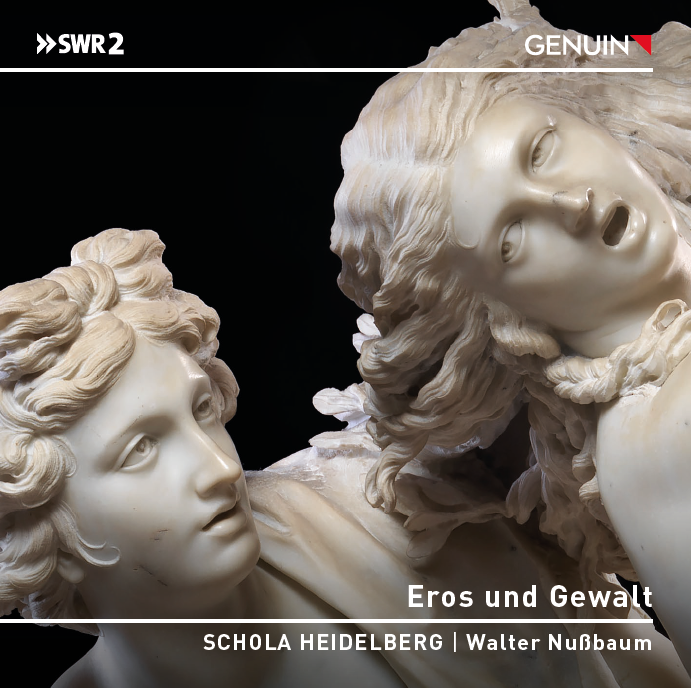
In the name of Eros und Gewalt ("Eros and Violence") works of vocal music – performed by the SCHOLA HEIDELBERG under Walter Nußbaum – converge with their poetic foundations: Italian madrigal poetry recited by actor Michael Rotschopf. But verses and songs meet on more than one level, for sung language is more than the linear sequence of its wording and texts, and far more than the cattalog of emotions of a lyrical "I" or a composing subject.
The lives or deaths of the two composers, Don Carlo Gesualdo da Venosa (1566–1613) and Claude Vivier (1948–1983), seem to have been marked by violence in one way or another: Gesualdo is said to have ordered a murder motivated by jealousy or a matter of honor, while Vivier was the victim of a murder driven by greed, desperation, passion. But which of these do we want to hear, which can we only read, which do we want to know? Must we understand “morte” literally as death, or – as a mannerism-obsessed elite audience around 1600 might have done – metaphorically as a euphemism for lust and sexual fulfillment – piece by piece, madrigal by madrigal? How morally pure (or impure) can these madrigals appear to us as recited, “pure text,” set apart from their music, and how foreign in the sound of that half-familiar Italian? In his music for female voices – simply titled Chants – Claude Vivier de- and reconstructs language itself from fragments of dreams, shards of thought, the consolation of a requiem, and Catholic Marian mysticism, perhaps not without traces of Eros and violence. For him, his work is a „ritual of rebirth“, but we also know: Music never allows – nowhere does this music or that of the madrigalists allow – the unambiguous decoding and identification of a lyrical self. And how misguided it would be to attempt to distinguish Gesualdo’s music morally from that of his ethically less conspicuous but aesthetically hardly more conventional contemporary Michelangelo Rossi (1601–1656) – beyond the social conventions and codes of honor of their time – unless through the act of listening.
Alongside Rossi (but also alongside Vivier), Gesualdo’s emotionally charged and chromatic harmonies – which, since Igor Stravinsky, have challenged and inspired countless contemporary composers – might not prove to be so isolated after all; rather, together with Rossi, they call into question, above all else, a supposed certainty of our musical practice today: the overly black-and-white keyboard pattern of equally tempered tuning and exactly identical tuning ratios, gray upon gray, chord by chord. In the colorful chromaticism of these madrigals, however, no two chords are alike. Just as no affect, no person, no life, and no death are alike. Neither Vivier’s nor Gesualdo’s music demands a direct biographical interpretation. Their levels form and remain a vast field of relationships: as a biotope, as a sociotope, as a topography of brain regions, and circumscribed purely by sounds and language.
Purchase amount: 16,00 €