Concert IV
as part of the "Hearing with Helmholtz" event series
Alte Aula der Universität Heidelberg
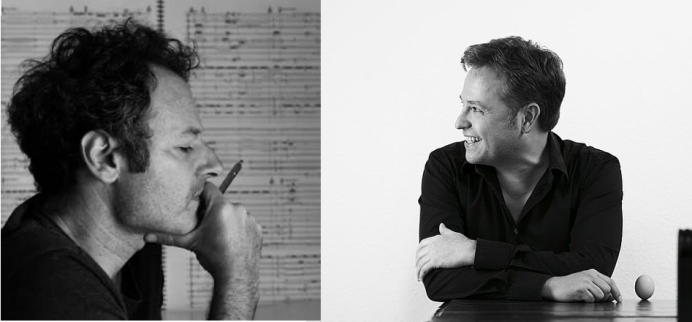
- Premiere — Arnulf Herrmann: alles gut., 2024
- Premiere — Valerio Sannicandro: chants contraires, 2024
Komposition:
- Johannes Brahms: aus: Vokalquartette op. 112, für 4 Stimmen und Klavier, 1888-1891
- Johannes Brahms: aus: 3 Vokalquartette op. 64, für 4 Stimmen und Klavier, 1874
- Richard Wagner: aus: Wesendonck-Lieder
- Henry Cowell: Sinister Resonance, 1930
- Henry Cowell: Aeolian Harp, 1923
- SolistInnen der SCHOLA HEIDELBERG
- SCHOLA HEIDELBERG | ensemble aisthesis
Moderation: Prof. Dr. Wolfgang W. Müller
Leitung: Walter Nußbaum & Ekkehard Windrich
Projectpresentation
Helmholtz' Research on Hearing (Marsilius Research Group)
with Prof. Dr. Christiane Wiesenfeldt (Department of Musicology) and PD Dr. André Rupp (Biomagnetism Section, Heidelberg University Hospital)
Composers’ Discussion with Arnulf Herrmann and Valerio Sannicandro
Round Table with all participants
"For even if scientific questions were intertwined with aesthetic ones, the latter were nevertheless of a relatively simple nature, while the former were certainly much more complex. This relationship must necessarily be reversed if one were to attempt to make further progress in the aesthetics of music, if one were to move on to the study of rhythm, compositional forms, and the means of musical expression. In all these areas, the peculiarities of sensory perception will still exert an influence here and there, but surely only in a very subordinate manner. The real difficulty will lie in the interplay of the psychological motives at work here. Of course, this is also where the more interesting part of musical aesthetics begins (…)" (Helmholtz)
One might go on to say that, after all, different rules apply in art, and Helmholtz was – as the final lines of his Theory of Sound Perception show – fully aware of this (...) The disturbances of harmony (combination tones, beats, low and very low tones, etc.) from the second chapter of The Theory of Sound Perception serve as the sonic material that forms the starting point – or the ladder – via which I will approach Rainer Maria Rilke’s poem The Madmen ("Die Irren"). (... He succeeds ...) in his poem The Madmen in capturing the paradox of an artistically almost crystalline description of complete instability. And this is – like all art – actually an impossibility.
Arnulf Herrmann, on the commissioned work "alles gut".