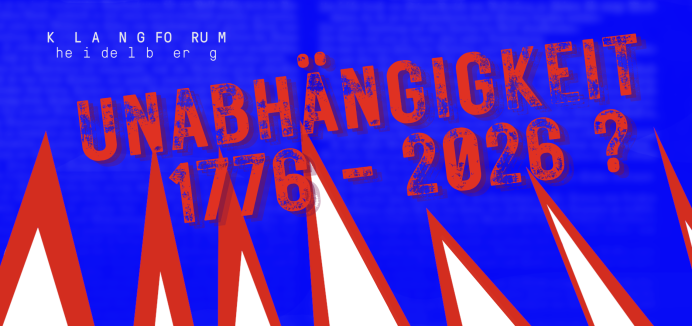
Independence 1776–2026 ?
Betriebswerk Heidelberg
Komposition:
- Joanne Metcalf: The Unfinished Dream, 2026
- Stefan Litwin: Kakerlaken - Eine New York Studie, 2024/2025
- Charles Ives: In Flanders Fields, for voice and piano; from: Three Songs of the War, 1917
- Carl Philipp Emanuel Bach: Die neue Litanei
- Charles Ives: Tom Sails Away, for voice and piano; from: Three Songs of the War, 1919
- Charles Ives: He is There!, for solo voice, choir and instruments; from: Three Songs of the War, 30 May 1917
- Arnold Schönberg: My Horses Ain't Hungry, Appalachian Folk Song, set by Arnold Schoenberg and completed by Allen Anderson
Mitwirkende:
- Sarah M. Newman — Sopran
- Karera Fujita — Sopran
- Ingvill Statle Skjørten — Mezzosopran
- Barbara Ostertag — Alt
- Manuel König — Tenor
- Hubert Mayer — Tenor
- Luciano Lodi — Bariton
- Florian Drexel — Bass
- J. Marc Reichow — Pianist
- Boris Müller — Schlagwerk
- Adam Weisman — Schlagzeug
- SCHOLA HEIDELBERG
- Kooperationsensemble aisthesis & friends
Leitung: Ekkehard Windrich
Veranstalter: KlangForum Heidelberg e.V.
The 250th anniversary of the Unanimous Declaration of the Thirteen United States of America (American Declaration of Independence) is approaching, yet what the most powerful nation on earth will look like at that point is anyone's guess.
This makes it all the more worthwhile to take a look at how the USA became the focal point of the European Enlightenment. For even though questions of money and power naturally played a prominent role in the separation from the English kingdom, the Declaration of Independence sought above all to anchor the enlightened individual in the public sphere and in the political decision-making structure.
Such efforts by individuals to develop themselves were typical of 18th-century Europe and were also reflected in a changed relationship to religion. In the preface to his “New Litany” (1786), Carl Philipp Emanuel Bach turns against the routine “chatter” of religious formulas and seeks to contribute to the acquisition of knowledge through harmonies that were modern for their time.
Given its own religious history, Europe would do well not to arrogantly dismiss the American form of Christianity, despite all its evangelical excesses. Religion and its free practice are at the heart of American democracy and are consciously reflected not least in the recent works of Joanne Metcalf (world premiere).
Although Charles Ives is no longer unknown, his significance for American music history and the artistic richness of his work are still underestimated. Rooted in the European concept of music, Ives subsequently broke new ground on his own: the way he developed his compositional techniques and methods seem to signify an aesthetic separation from the old continent. Ives' impressive songwriting shows both his intimate knowledge of the European heritage and the self-confident cultural independence of the USA.
It is an exciting and speculative question how the classical music scene in the USA would have developed after Ives without the forced influx of the brightest minds after 1933 – in this context, the phrase “vanishing point of the European Enlightenment” takes on a whole new dimension. The influence of Arnold Schönberg can still be felt in the USA today. His arrangement of the traditional song “My Horses Ain't Hungry”, as completed after the sketches by Allen Anderson, concludes the program as its European premiere.
In “Kakerlaken - Eine New York Studie” (world premiere), Stefan Litwin offers a scathing, grimly optimistic outlook on the future. Uwe Johnson's text about the omnipresence of cockroaches as secret rulers of New York and their notorious ability to survive seems like an ironic metaphor for the indestructibility of American democracy.
One can still hope, after all.
Podcast "Independence – Section 1"
Introduction "The inevitable"
Podcast "Independence – Section 2"
"C.P.E. Bach and the Enlightenment"
Podcast "Independence – Section 3"
"Joanne Metcalf and the Unfinished USA"
Podcast "Independence – Section 4"
"Charles Ives and Embracing Differences"
Podcast "Independence – Section 5"
"Stefan Litwin and the Least Common Denominator"
Podcast "Independence – Section 6"
"Arnold Schoenberg, Allen Anderson, and a Folk Song"
Further information here.