IMAGINE
The freedom of others
The farmers back then – and us today
Social change and systemic crises are historical constants. In the run-up to the German Peasants' War, not only were taxes and corvée labor gradually increased, exacerbating the peasants' misery to an unbearable degree, but conditions were also being challenged from within, for example by Hus, Savonarola, Luther, Erasmus, and Zwingli. The loss of legitimacy of the “divine order” ultimately led to appalling excesses of violence.
The plight of the Chinese rural population at the beginning of the 20th century was also depressing evidence of the crisis in the traditional social model. During the civil war, Mao and the Communist Party relied on peasants who were often poorly armed and who paid a terrible price in blood for their success. Initially, the reforms of the Communist Party alleviated the misery of the peasants. But the Great Leap Forward, which was supposed to make China a world leader in industry and agriculture, ended in the most devastating and avoidable famine in human history, as well as brutal oppression.
In IMAGINE – Die Freiheit der Anderen (IMAGINE – The Freedom of Others), we want to ask questions about the present. Whether these questions concern the contrasts between rich and poor, urban and rural, or young and old, we leave it up to the young people from the KlangClub and the AG Gegenklang from the Elisabeth-von-Thadden Gymnasium. After all, those who are most affected by these issues also have the keenest sense of social upheaval.
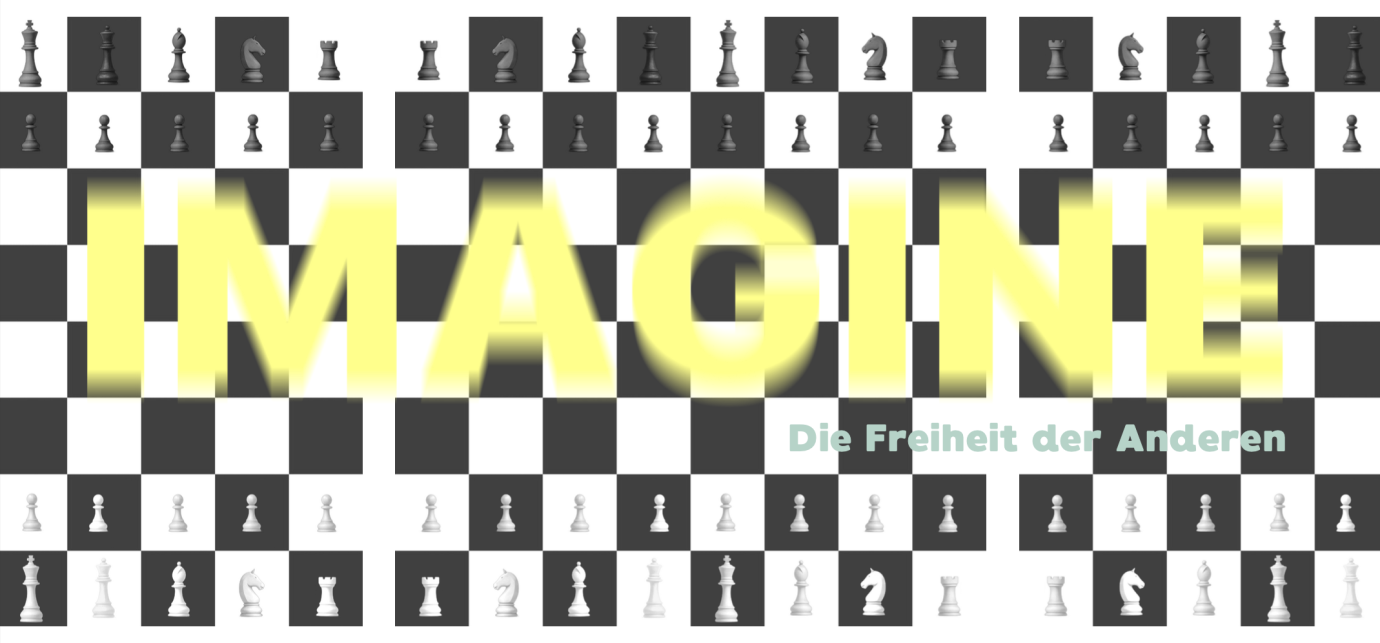
The stage action takes place on a large chessboard with electroacoustically amplified squares that can be played in various ways. The young people not only interact with digital sound effects, but also sing together with SCHOLA HEIDELBERG, supported by the ensemble aisthesis.
Auf dem Programm dieser rasanten Nummernrevue zwischen Musikstilen, The program for this fast-paced revue, which spans musical styles, cultures, and centuries, also includes works by Jacob Obrecht and Ludwig Senfl from the period of the German Peasants' War, as well as Valerio Sannicandro's “Chants contraires.”
Rehearsals with the KlangClub and the AG Gegenklang began in May and took place on an equal footing between the generations. One thing is already clear: the learning effect is at least as great for the adults as it is for the young people.
“IMAGINE – The Freedom of Others” – Music education project addressing the big question of social justice
22.11.25 | 19:00 | Hebelhalle Heidelberg | Tickets
23.11.25 | 17:00 | Hebelhalle Heidelberg | Tickets
24.11.25 | 09:15 & 11:45 | Hebelhalle Heidelberg | Voranmeldung
Contributors
Teenagers:
Alina Thebes
Cato Stoevesandt
Elias Schneider
Ella Stalitza
Emily Nagel
Fridolin Balbach
Gwenda Hess
Jakob Krüger
Johanna Giebels
Karla Welsch
Leander Großmann
Linus Reiber
Madita Bremen
Mats Schulz
Miriam Jahn
Robert Hanich
Sarah Paulus
Theresa Psoch
Theresa Rondot
SCHOLA HEIDELBERG
Sarah Kuppinger | Soprano
Dorothea Jakob | Soprano
Barbara Ostertag | Alto
Christoph Eder | Tenor
Ferdinand Junghänel | Baritone
Raphael Ries | Bass
ensemble aisthesis
Boris Müller | Percussion
Yukari Yagi | Percussion
AG GegenKlang of Elisabeth-von-Thadden Gymnasium | Johannes Balbach
SCHOLA HEIDELBERG & ensemble aisthesis | Ekkehard Windrich, conductor
Magdalena Erhard and Nelly Sautter | Music education
Felicitas Vajna | Narrator
Bernhard Fauser | Lighting
J. Marc Reichow | Sound
Natascha Hund, Jule Hock, Paul Weber, David Nußbaum, Ming Ly Chang, Dominique Mayr | Production
In cooperation with the Confucius Institute at Heidelberg University.
Supported by the Friederike Lehrnickel Foundation and Sparkasse Heidelberg.
Guest performance at the Hebelhalle by Unterwegstheater.
In Kooperation mit dem Konfuzius Institut an der Universität Heidelberg.
Unterstützt durch die Friederike-Lehrnickel-Stiftung und die Sparkasse Heidelberg.
Zu Gast in der Hebelhalle beim Unterwegstheater.